Request a FREE Quote




We all love the shopping spree when it is this easy!
Shopping is Therapy, and we all know that. Especially in today’s digital era, it is possible with a single tap on a link that leads to our favourite clothing or accessory pages. E-commerce is evolving at a very quick pace. The transformation of consumer behavior, marketing dynamics, and technology has led the retailer and business sectors to recognize the necessity of adapting to the new scenario as we move through 2026.
This year promises to be transformative, with AI-driven innovations, sustainable practices, and a renewed focus on customer experience reshaping how we buy and sell online. Let’s understand the e-commerce trends for retail brands & Businesses in this ever-changing e-commerce landscape through this Blog.
2026 might just be the pivotal point where the e-commerce era takes a turning point. Even though e-commerce has been mature enough for a long time, this year is bringing significant changes as consumer expectations and market competition are fiercer than ever, especially since the technological advances are more sophisticated now. The creation of an Omnichannel ecosystem that needs flawless integration and coordination is blurring the lines between actual real-life shopping & online retail.
The 2026 E-commerce trends for startups, businesses, and retail are no longer just about social media presentation or good websites. It has gotten to a point where leveraging the right technology, Data, automation, and Human insights plays an important role.
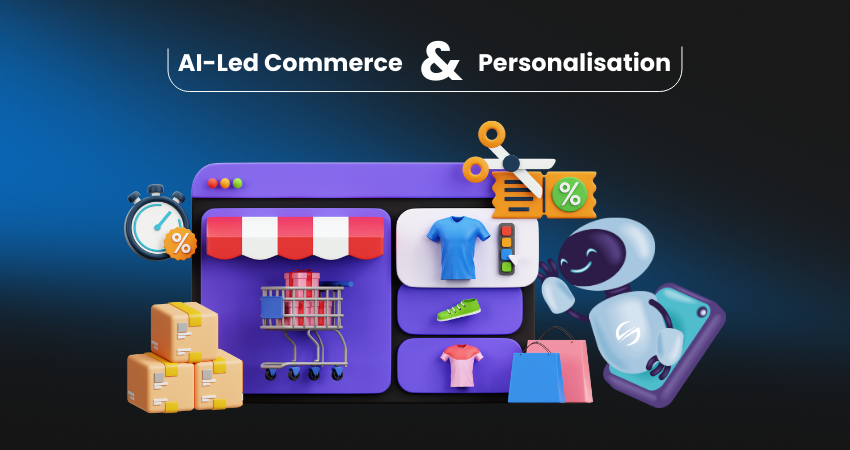
Artificial Intelligence is not just a novelty anymore in the E-Commerce industry. In the competitive age of 2026, it has become the foundation of advantage in the competitive landscape. The hyper-personalization has removed the basic AI product recommendations. The customer shopping experiences are now simultaneously delivered using machine learning algorithms. It helps in adjusting pricing, product displays & content – based on individual behaviour patterns and preferences.
AI today has become more intelligent as it is able to learn directly from the customer’s behaviour in real time. Rather than just predicting what a customer might buy, it knows the shopping habits of people in India, the perfect moment to reach out to them, and the types of messages that are most likely to elicit a response from them – be it a personalized offer, a WhatsApp update, or a deal based on a festival.
Automation across the E-Commerce Lifecycle
From awareness to advocacy, smart automation orchestrates everything included in a customer journey. Automation is no longer just about email and inventory limited. Freeing more human talent in actual content & strategy planning, AI is managing marketing workflows, fulfillment, customer services, and content creation too!
Businesses are discovering how automation is transforming and not eliminating jobs, actually. This includes:
Teams are now focusing more on creativity, genuine human connections, and strategic thinking rather than on repetitive tasks. The real challenge is to leverage Automation thoughtfully to enhance the customer experience.
Customer experiences are now the ultimate differentiators in jam-packed market spaces where products & prices are increasingly comparable. CX goes beyond checkout processes. It incorporates every touchpoint – from product discovery to customer services and post-purchase to community building. Custom e-commerce development can help in enhancing such features.
By removing the friction in purchase time and customer needs, practitioners are creating wonderful e-commerce website designs now. It includes:
Customers engage naturally when a brand tells engaging stories that demonstrate the genuine values of the company and build loyalty from customers.
An e-commerce development Company can help you perfectly in analysing the gaps and develop a Website for your brand.
The unified marketplaces that flawlessly integrate multiple sellers, brands, and inventory sources will be involved in the Future E-Commerce stand. Be it buying from direct retailers’ inventory, marketplace partners, or third-party sellers, customers are expecting a coherent and single experience only. Using AI to curate tailored product assortments that will anticipate the consumer’s needs beforehand is becoming the norm in predictive marketplaces.
This shift ensures platforms can manage multiple seller relationships, perform complex logistics networks, and maintain consistent brand experiences.
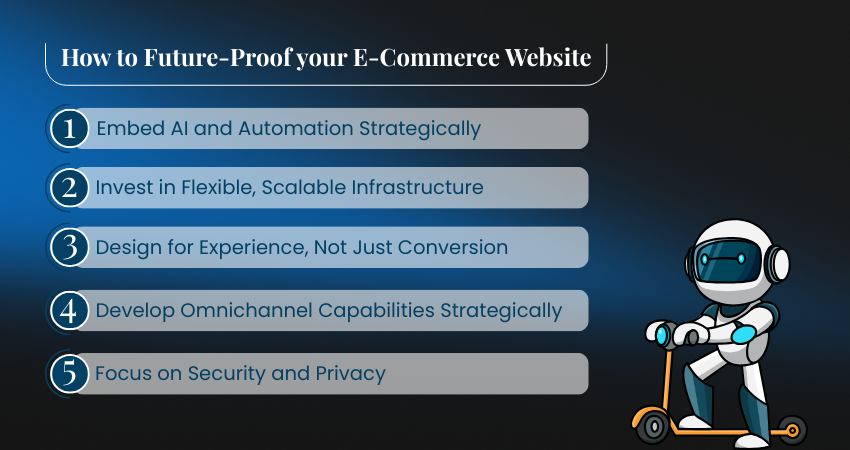
Future proofing an E-Commerce website is more about being strategic in a systematic way than simply following the trends, as the implementation is a real challenging factor. Below are key recommendations you can use to do so:
Use AI and automation where they create measurable value – customisation, foretelling, fraud detection, and customer support – while maintaining human oversight for quality and trust. Don’t use automation to just automate things. Train your team strategically to work alongside AI and leverage it appropriately where it is needed.
Begin with your technical base. Choose cloud-oriented solutions and composable architecture that let you add, remove, or even upgrade components without total system overhauls. Do not use proprietary platforms that keep you locked into certain vendors. Go for open standards and APIs that support integration with the best of the best solutions instead. This versatility opens up the possibility of quick changes as technology develops and new chances arise.
Optimise your website for usability, accessibility, and emotional engagement. The quick navigation and checkout help customers with time management while shopping online. The quicker the better! A future-proof e-commerce website accentuates long-term customer relationships rather than concentrating on short-term sales metrics.
Plan for expansion so you don’t stay everywhere at once. See the channel where your niche’s audience is timely active and interacting, and then strategically develop adjacent channels. It is very important to have the same visibility of inventory, pricing, and customer data across all the channels. Apply headless commerce so that channel expansion with no changes in the backend is allowed at a quicker pace.
In the meantime, security had to be non-negotiable as cyber threats had already moved one step further.
Also, keep the systems equipped with the latest patches. Privacy was the equal of security, always and everywhere. So, be open about data harvesting, give conclusive consent and withdrawal options, and reduce your collection of data to only that which is absolutely required.
E-commerce website Design & e-commerce website Development are both taking pivotal turns in 2026 as we move forward toward AI personalisation, CX focused Custom e-commerce development, and Automation. The next generation of e-commerce platforms will have more individual-based expectations on them. By leveraging the best ecommerce technology in 2026, retailers, B2B owners can provide amazing Customer Experiences. Thus, understanding these B2B ecommerce trends 2026 is necessary in this rapidly developing E-Commerce landscape.

A Fun application that allows you to combine two images in a different way. You can modify, resize, move the either of the images and can have fun showing to your colleague/friends. Sprybit made that with very ease.

My app has been recognized by many stores and it is very easy to use in both Android and IOS. Thanks to SpryBit team for making my idea come in reality

SpryBit was a pleasure to work with. From the beginning they had a clear idea how to execute my vision for the website I wanted. Their project managers were clear and helpful in their communication, and kept me up to date with expectation and deadlines. Their developers were happy to modify and improve code based on our needs. Would be excited to work with SpryBit again.
Specially Thank you! for visiting.
Contact us OR call us to get FREE estimate